Thông tin ngành học | Khoa Công học và Khoa học tự nhiên | Trường Đại học Tei...



Scholarship Opportunity for Scout Users Only (Enrollment Period Required)


Trang thông tin về du học đại học,cao học tại Nhật JPSS > Tìm nơi du học từ Tokyo Đại học > Trường Đại học Teikyo > Khoa Công học và Khoa học tự nhiên
Dành cho các bạn đang có dự định du học trường Trường Đại học Teikyo. JAPAN STUDY SUPPORT là trang thông tin về du học Nhật Bản dành cho du học sinh nước ngoài, được đồng vận hành bởi Hiệp hội Asia Gakusei Bunka và Công ty cổ phần Benesse Corporation. Trang này đăng các thông tin Ngành Khoa Văn họchoặcNgành Khoa Kinh tếhoặcNgành Khoa LuậthoặcNgành Khoa Công học và Khoa học tự nhiênhoặcNgành Khoa Ngoại ngữhoặcNgành Khoa Giáo dục của Trường Đại học Teikyo cũng như thông tin chi tiết về từng ngành học, nên nếu bạn đang tìm hiểu thông tin du học liên quan tới Trường Đại học Teikyo thì hãy sử dụng trang web này.Ngoài ra còn có cả thông tin của khoảng 1.300 trường đại học, cao học, trường đại học ngắn hạn, trường chuyên môn đang tiếp nhận du học sinh.
間もなく出願開始!
帝京大学では、幅広い分野から自分の興味や将来の目標に合わせて学部・学科を選ぶことができます。
■八王子キャンパス:経済学部/法学部/文学部/外国語学部/教育学部
■宇都宮キャンパス:経済学部 地域経済学科/理工学部
これらの学部・学科を対象とした2027年度留学生特別選抜の出願がまもなく始まります。
■試験の種類
・自己推薦方式:書類審査および口頭試問
・A方式:日本語の問題<筆記試験>
・B方式:日本留学試験成績利用
※自己推薦方式はⅠ期のみ実施します。
※学部・学科により試験内容が異なります。
■出願期間
Ⅰ期:2026年10月7日(水)~10月15日(木)
Ⅱ期:2027年1月5日(火)~1月12日(火)
詳細は、2027年度留学生特別入試要項をご覧ください。
https://www.teikyo-u.ac.jp/applicants/international/nonnative
帝京大学 Teikyo University
【JP】https://www.jpss.jp/ja/univ/314/
【EN】https://www.jpss.jp/en/univ/314/
kokusai@teikyo-u.ac.jp




In today’s society, where a variety of issues are intricately intertwined on a global scale, engineers need a broad perspective. Through practical, hands-on learning in the Faculty of Science and Engineering — including experiments and exercises, theoretical calculations, and human-factors-based applied education — students acquire a broad range of knowledge in basic science, engineering, and the life sciences. By providing opportunities to learn practical skills directly connected to engineering practice and cutting-edge technologies, the faculty aims to produce engineers with originality who will lead the next era. In addition, beyond such specialized expertise, it cultivates individuals with sound judgment and an international outlook who can help build a world in which everyone can live in peace and fairly enjoy abundant resources and the benefits of civilization.
The Course is characterized by practical learning that is directly applicable to society. It fosters a strong motivation for manufacturing, along with rich sensitivity and originality, and students learn about mechanical engineering and aerospace engineering through practical training and special projects.
The Course offers practical education with a strong emphasis on experiments and hands-on training. Based on robotics engineering and artificial intelligence, students acquire knowledge across fields such as medicine, biotechnology, information science, mechanical engineering, and aerospace engineering. The course aims to nurture people with a broad perspective and strong creativity.
In the Course, students aim to develop the ability to utilize cutting-edge information technologies. They can learn about information technology, data science and AI, and technologies for media expression through the theories of information science that form the foundation of these fields. In this way, students develop the ability to adapt to new technologies as well as the ability to use them effectively.
In the Course, students acquire principles and fundamental techniques through experiments. In addition to understanding the environment and life at the molecular level, they also gain knowledge and skills related to food and pharmaceutical development that apply life science and biotechnology.
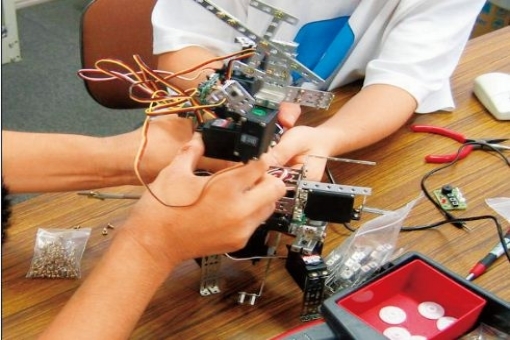
A robot building exercise
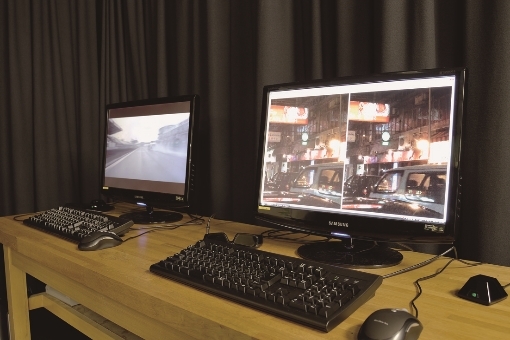
A human electronics experiment


We aim to cultivate individuals with strong motivation, rich sensitivity, and originality toward manufacturing, who possess advanced specialized skills and broad knowledge in mechanical engineering and its applied fields of aerospace engineering. These individuals will also demonstrate proactiveness and creativity to meet the diverse demands of an evolving society.
Studying robotics and artificial intelligence by acquiring knowledge of different fields such as municipalities, medicine, biotechnology, information, and aeronautics, will lead our students to gain a broad perspective and a high level of creativity. We anticipate that graduates from this course will play an active role in manufacturing industries, information and communication industries, and research institutes related to robotics, intelligent robotics, electrical and electronic engineering, and informatics.
Students learn about information technology, data science and AI, and technologies for media expression through the theories of information science that form the foundation of these fields. In addition, there are exercises in which students generate their own AI, as well as practical training in which they develop information systems in teams in a manner similar to actual business operations. The program aims to develop practical skills that enable students to collaborate with others and contribute to solving environmental and social issues.
This program seeks to foster the development of human resources who can solve various societal problems through their own initiative from a broad perspective of life and the environment. Students will acquire not only the ability to understand the environment and life at the molecular level, but also gain a wide range of knowledge and skills in areas of applied life science and biotechnology, such as food and drug development.