Faculty information | School of Transdisciplinary Science and Design | Univer...



Scholarship Opportunity for Scout Users Only (Enrollment Period Required)


JPSS, for information about studying in Japan's universities and graduate schools. > Search Japanese Universities in Ibaraki. > University of Tsukuba > School of Transdisciplinary Science and Design
To Foreign Students Considering Studying in University of Tsukuba. JAPAN STUDY SUPPORT is a website jointly operated by The Asian Students Cultural Association and Benesse Corporation. It provides information about studying in Japan.
The website also provides detailed information about University of Tsukuba and its faculties of School of Transdisciplinary Science and Design, School of Humanities and Culture, School of Human Sciences, School of Science and Engineering, School of Medicine and Health Sciences, School of Physical Education, Health and Sport Sciences, School of Art and Design, School of Informatics, School of Social and International Studies, School of Life and Environmental Sciences, Japan-Expert Program, and Bachelor's Program in Global Issues. Take full advantage of the site to learn everything you would like to know about University of Tsukuba.
In addition, information for about 1,300 universities, graduate schools, two-year colleges, and vocational schools that accept foreign students is also posted.
 Ibaraki / National


The application guide for the September 2027 intake at the University of Tsukuba Malaysia (UTMy) is now available.
■View the Application Guide: https://bit.ly/4B8Nl3q
Prospective applicants are encouraged to read the guide carefully to check their eligibility, understand the application procedures, and prepare the required documents in advance.
Those considering applying in a future intake may also refer to the guide for information about the admissions process.
[Eligibility]
Applicants must have completed, or be expected to complete, 12 years of formal education by 31 August 2027 and hold an eligible qualification. Accepted qualifications include STPM, UEC, A Level, EJU, Foundation, Matriculation, Diploma, a Japanese high school diploma, or an equivalent qualification.
Please refer to the application guide for the full eligibility criteria.
[Application Schemes]
UTMy offers two application schemes:
<School Recommendation Scheme>
Applicants must be nationals of an ASEAN country or have completed at least five years of secondary education in ASEAN countries. They must also provide evidence of their Japanese-language background.
<Aptitude-based Scheme>
Applicants are not required to have prior knowledge of Japanese.
<Interviews>
Interviews for both application schemes will be conducted in person at UTMy in Kuala Lumpur. Online interviews will not be available.
<Find Out More About UTMy>
Interested in studying at UTMy? Join our next Open Day on Saturday, 5 December 2026 to learn more about the programme, admissions process, and student experience.
(Registration: https://forms.cloud.microsoft/r/Hb8anUAMWt)
For enquiries about the application process or required documents, please contact the Academic Service Office at utmy-kyomu@un.tsukuba.ac.jp.
We look forward to hearing from prospective students and learning about their interests and aspirations.


The School of Transdisciplinary Science and Design (University of Tsukuba, Malaysia: UTMy) is the first overseas campus of a Japanese university to award Japanese degrees outside Japan. UTMy is dedicated to developing globally minded graduates who can address complex global issues through problem-solving.
UTMy has established a truly transdisciplinary education team, bringing together academic staff from a wide range of fields. It also offers an advanced curriculum centred on Problem-Based Learning (PBL).
Designed around the principles of design thinking, the UTMy curriculum places data science at its core and draws on knowledge from both the sciences and humanities and social sciences to develop advanced approaches to problem-solving.
Students at UTMy are awarded a Bachelor of Arts and Science degree. This is a Japanese degree awarded by the University of Tsukuba and is backed by the same academic standards and quality assurance as a degree awarded at the University of Tsukuba in Japan.
【1. Continuous Problem-Based Learning (PBL)】
Students learn by identifying problems themselves and developing solutions to address them. The value of PBL lies not simply in the final outcome, but in the learning process itself — discovering new knowledge and, ultimately, learning how to learn.
Many PBL projects are carried out in teams, where discussions with team members, academic staff and people involved in the project play a key role in identifying the right problems and finding effective solutions. Students are therefore encouraged to develop strong communication skills, particularly in English.
Multiple academic staff members act as facilitators, guiding students through projects covering a wide range of topics, from the natural sciences to the humanities and social sciences. This enables students to approach each project from a fresh perspective.
Through continuous PBL, students develop the ability to learn independently and communicate effectively, while building the skills and confidence needed to tackle global issues throughout their lives.
【2. An Innovative Approach to Learning Data Science】
Addressing global challenges requires the ability to analyse global data and use evidence to predict the potential impact of proposed solutions. For this reason, developing data science skills is essential.
A fundamental part of understanding and effectively applying data science is a solid grasp of the mathematics behind it. To help students acquire these skills effectively within the time available, UTMy has developed an approach that differs from a conventional science-based curriculum.
In their first year, students study information literacy and the fundamentals of probability and statistics alongside programming. In their second year, they gain a broad foundation in both the natural sciences and the humanities and social sciences, while exploring their connections with data science. Through this process, students discover how many scientific questions are closely linked to mathematics, helping to increase their motivation to study it.
In their third year, students study the mathematical foundations of data science. By first building sufficient readiness and motivation to learn the necessary mathematics, students can develop a deeper understanding of data science.
Students also apply their data science skills through PBL according to their level of understanding, gradually developing practical skills throughout the four-year programme.
【3. Learning Across Disciplines】
Solving global issues requires us to look at problems from multiple perspectives and select the best solution from a range of possible approaches that can be put into practice. To achieve this, students need to develop the ability to think beyond the boundaries of individual academic disciplines.
Transdisciplinary education is one of the key strengths of the University of Tsukuba. In their first year, students are introduced to interdisciplinary perspectives through university-wide subjects. In their second year, they build a broad foundation across the natural sciences, humanities and social sciences. In their third year, they use this broad foundation to explore more advanced areas of study.
The ability to bring together academic staff from a diverse range of disciplines is another major strength of the University of Tsukuba, enabling UTMy to provide students with a truly transdisciplinary learning environment.
【Born from a Japan–Malaysia Summit】
UTMy was established following a 2018 meeting between former Japanese Prime Minister Shinzo Abe and former Malaysian Prime Minister Dr. Mahathir Mohamad.
The opening ceremony of UTMy, held in September 2024, was attended by numerous government representatives from both Japan and Malaysia. Former Prime Minister Mahathir also delivered a special lecture, offering his strong support and congratulations on the establishment of UTMy.
【From the Asian Gateway to the World】
UTMy is pioneering a new model of education by bringing the University of Tsukuba’s strengths in interdisciplinary and international education to Asia. As a result, UTMy is expected to serve as an Asian Gateway — a hub for developing networks of highly skilled people connecting Japan and Asia.
Through collaboration among a diverse, multidisciplinary team of academic staff and students from different countries, UTMy is creating a truly open learning environment that is unique on a global scale.
As an “open university”, UTMy represents an ambitious project that builds on the University of Tsukuba’s long-standing spirit of openness and develops it further for the world of the future.
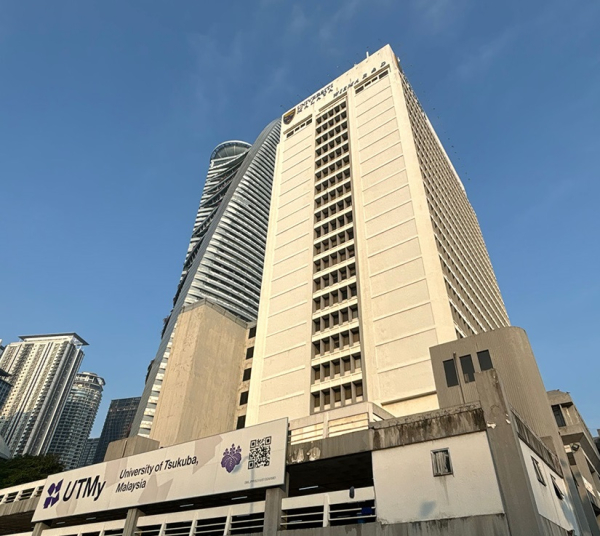
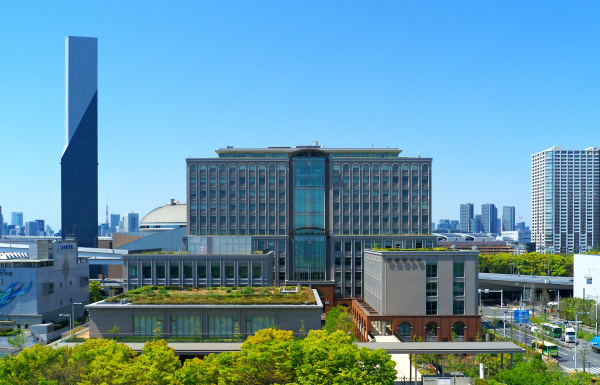
Occupying seven floors of the Wisma R&D Building at Universiti Malaya
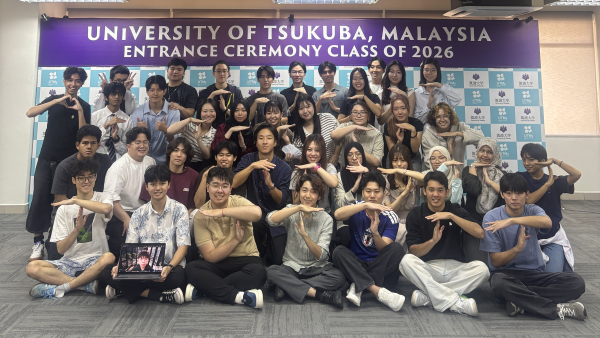
September 2026 Orientation Programme
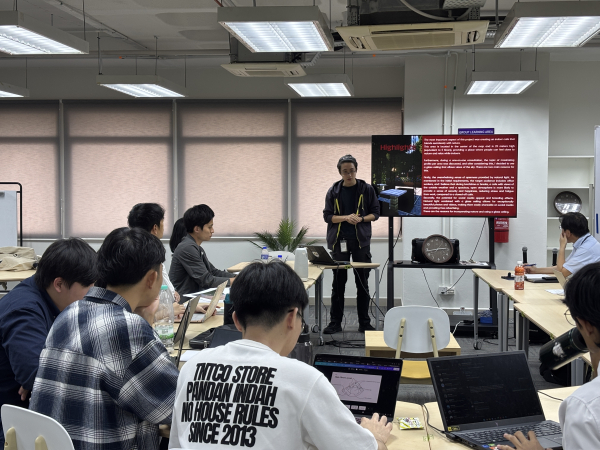
Final PBL Presentation